
Health Insurance Coverage for Teen Rehab Treatment in Dallas, Texas
At BasePoint Academy, we know families already have enough to think about. Our team works directly with your insurance provider to verify benefits and explain your coverage clearly, so you can focus on supporting your child.
BasePoint Academy Accepts Health Insurance
Situated in the dynamic heart of Texas near Dallas, BasePoint Academy is a trusted provider of insurance-covered teen mental health treatment. With state-of-the-art facilities in Arlington, Forney, McKinney, and Frisco, we help adolescents navigate a wide range of mental health conditions—including teen depression, anxiety, ADHD, behavioral issues, eating disorders, self-harm, and bipolar disorder. Our adolescent-focused PHP and IOP programs are in-network with most major insurance plans, making high-quality, clinically proven care more accessible for families.
At BasePoint Academy, we know that understanding insurance coverage can feel overwhelming. That’s why we work directly with your provider to verify benefits, explain coverage levels, and confirm whether your plan includes mental health treatment for teens. Whether your family needs therapy, psychiatric services, or dual diagnosis treatment, our team ensures finances are not a barrier to receiving the help your teen deserves. We’re here to guide you step-by-step toward clarity, confidence, and the right level of care for your child.
What is Mental Health Treatment Insurance Coverage?
Does Insurance Cover Mental Health Treatment in Texas?
Yes, according to the ACA, policies must cover mental health treatment. This means that treatments for conditions ranging from depression and anxiety to eating disorders, substance use disorder, schizophrenia and PTSD can be covered by insurance.
However, not all policies are the same. Details and treatment levels may vary depending on the insurance plan and other factors.

Does Insurance Cover Therapy for My Child?
If you’re wondering, “Does insurance cover therapy for my child?” the answer is generally yes. Insurance plans typically cover a wide range of mental health treatments, including psychotherapy, counseling, and Cognitive-Behavioral Therapy (CBT). These services can be delivered through various formats, such as individual therapy, group therapy, or family therapy, depending on your child’s needs and your insurance coverage .
However, the extent of coverage can vary significantly depending on your specific insurance plan and other factors. Some policies may cover other therapeutic approaches like Dialectical Behavior Therapy (DBT), trauma therapy, and holistic therapy. It’s crucial to check with your insurance provider to understand what types of psychological counseling are covered and any out-of-pocket costs you might be responsible for.
The federal parity law also requires insurance companies to treat mental and behavioral health and substance use disorder coverage equal to (or better than) medical/surgical coverage. Therefore, seeking help for your child’s mental health concerns should not be a financial burden but rather a path to their well-being.
Does Insurance Cover Mental Health Services for My Child?
Yes, health insurance policies typically cover mental health, substance abuse and dual diagnosis treatment for your child. You can also keep your adolescent or young adult on your insurance policy until they’re 26. Mental health coverage is considered an essential health benefit mandated by the ACA. Call BasePoint Academy today and speak with one of our admissions specialists to verify your mental health benefits and learn more about how our programs can help your family.

Mental Health Therapy Treatments Covered by Health Insurance
Most health insurance policies are mandated by the Affordable Care Act to offer mental health treatment options, but coverage details vary. At BasePoint Academy, our licensed and experienced mental health professionals develop individualized programs to meet each teen’s needs. Programs can include crisis stabilization, partial hospitalization programs, intensive outpatient programs, and relapse prevention.
Health Insurance Coverage for Crisis Stabilization
When teens reach a point where they can no longer cope and keep themselves safe, they may need crisis stabilization to help de-escalate the situation. These are services that are part of a short-term mental health treatment intended to mitigate a permanent psychiatric or behavioral health crisis and reduce the acute symptoms you see in your child.
Insurance typically covers crisis stabilization services delivered in an intensive outpatient or partial hospitalization program. The experienced healthcare professionals at BasePoint Academy will determine the best level of care where crisis stabilization can be provided by utilizing evidence-based assessments and processes to determine their recommendations.
Health Insurance Coverage for Partial Hospitalization Programs (PHP)
A Partial Hospitalization Program (PHP) allows your teen to get the help they need without round-the-clock care or checking into a residential program. PHP programs deliver a comprehensive level of care over a full day of treatment, while allowing your teen to go home in the evening and practice the skills they’ve learned in their home environment.
Mental health insurance typically covers PHP programs for teenagers. Since the program is not residential, it is often more cost-effective, while delivering appropriate care and allowing teens to live at home with their family. A customized treatment plan is developed after a detailed evaluation and BasePoint Academy works with mental health insurance companies that require prior authorization before treatment begins.
Health Insurance Coverage for Intensive Outpatient Program (IOP)
Intensive Outpatient Programs (IOP) for mental health and substance abuse offer your teen daily treatment customized to meet their needs. Treatment options can include medication, family therapy, group therapy, individual therapy sessions, and aftercare plans. An IOP can help teens struggling with Post-Traumatic Stress Disorder (PTSD), substance use, depression, stress, and other mental health conditions.
Most health insurance policies typically cover IOP programs. Your coverage will vary depending on your policy and other factors, so there may be some out-of-pocket costs. Generally, health insurance policies with a lower monthly premium may cover a lower percentage of your treatment costs than those with a higher monthly premium. The insurance provider may also require an annual deductible and prior authorization before treatment can begin.
Health Insurance Coverage for Relapse Prevention
A relapse prevention plan helps your teen identify unhealthy behaviors and take action before they experience a physical relapse. Each plan is customized and teens are encouraged to share that plan with their immediate support network. An effective relapse prevention plan includes actionable steps teens can take to help manage or mitigate known triggers and cravings before a physical relapse.
A relapse prevention program is integrated into your teen’s customized treatment plan and is typically covered by your health insurance policy. If your insurance policy requires pre-authorization, the relapse prevention program will be part of the treatment plan submitted to the health insurance company. BasePoint Academy encourages you to call (972) 357-1749 to verify your coverage and request a complimentary same-day assessment.
What Types of Teen Mental Health Disorders Does Insurance Cover?
In recent years, greater awareness of teen mental health has led to major improvements in how insurance companies cover behavioral and emotional disorders. Today, most health plans help families access evidence-based teen mental health treatment, including therapy, psychiatry, and structured programs like PHP and IOP. Because coverage varies by insurer and plan type, it’s important for parents to understand which conditions are commonly covered and what benefits their teen may qualify for.
Below is an overview of teen mental health disorders typically covered by insurance, all of which can be treated at BasePoint Academy.
Treatment for Bipolar Disorder in Teenagers
Bipolar disorder involves cycles of depression and mania or elevated mood, and symptoms can look different in every teen. Our licensed clinicians create individualized treatment plans using the latest research in adolescent mood disorders, helping teens stabilize emotions, improve functioning, and build healthy coping skills.
State and federal mental health parity laws require most insurance plans to cover treatment for bipolar disorder. Because this condition often requires ongoing therapy, psychiatric care, and structured support, insurance coverage plays a key role in accessing the right level of care. Mental health is considered an essential health benefit, meaning insurers cannot place lifetime limits on coverage—but each plan may differ in how services are authorized or approved.
Treatment for Anxiety Disorder in Teenagers
Anxiety is normal from time to time. However, it can develop into a more serious mental health issue when the proper treatment isn’t received. BasePoint Academy’s licensed professionals aim to help your teen overcome challenges related to anxiety disorders using a holistic, evidence-based therapy perspective that’s invested in your teen’s well-being and helps to identify and process anxiety-related symptoms.
Insurance policies typically cover anxiety treatment in teens. Through customized treatment plans designed to meet the needs of each teenager, BasePoint Academy works with insurance companies that require prior authorization and provides them with the necessary documentation to approve care.
Treatment for Depression in Teenagers
Your teenager is dealing with stresses that you likely didn’t face. In addition to the hormones, emotions, and social pressures, today’s teens are also facing social media bullies and witnessing close family members or friends with physical or mental health issues. BasePoint Academy offers your teen an integrative approach to address emotionally charged issues, including depression and stress.
The Affordable Care Act (ACA) mandates that all insurance policies offer treatment for mental health conditions like depression. However, each insurance policy differs, and your out-of-pocket costs can vary. Contact us today to verify your coverage and request a complimentary same-day assessment.
Treatment for Trauma in Teenagers
Trauma comes in all shapes and sizes. Causes vary from short-term events to long-term physically or emotionally traumatic experiences. Treatment at BasePoint Academy begins the healing process through a variety of holistic and evidence-based modalities, during which the teen works with a licensed, experienced professionals equipped to handle the intense impact trauma has on teenage well-being.
Your insurance plan typically covers treatment for teenage trauma. Still, your out-of-pocket costs can vary depending on your plan, deductibles, copayments, and more. It’s a good idea to know what’s included, if prior authorization for treatment is required, and to verify your mental health insurance coverage.
Treatment for Teens with Suicidal Thoughts
Suicidal ideation is when a teen has thoughts of suicide. It is not necessarily to create a plan or attempt suicide. However, to entertain the idea can lead to hopelessness, Substance Use Disorder (SUD), or other challenges. There are several ways to help teens navigate suicidal ideation, and BasePoint Academy is equipped to incorporate these into a customized treatment plan.
Typically, insurance policies cover treatment for teens who have thoughts of suicide. Your out-of-pocket costs vary depending on your insurance policy, deductibles, and copayment. Your insurance policy may have limits on therapy sessions or outpatient treatment. Verifying your insurance coverage details and submitting any necessary pre-authorization paperwork before accessing your benefits is crucial.
Treatment for Dual Diagnosis Disorders
Dual diagnosis, also called a co-occurring disorder, is when a mental health condition occurs alongside a substance use disorder. This can include alcoholism and depression or anxiety and Opioid Use Disorder (OUD). One condition does not necessarily cause the other, but a dual diagnosis is typically more challenging. Experienced professionals must treat each condition simultaneously to prevent relapse.
Insurance policies typically cover substance use disorders and co-occurring mental health conditions. The extent of the coverage can vary, and some health insurance companies require prior authorization. You can reduce your out-of-pocket expenses by working alongside your insurance company to provide them with the necessary documentation to access your benefits. Call BasePoint Academy today at (972) 357-1749 for help verifying your coverage and determining if you need prior authorization.
Treatment for DMDD in Teenagers
Disruptive Mood Dysregulation Disorder (DMDD) is a childhood mood disorder marked by severe irritability, frequent temper outbursts, and persistent anger. Teens with DMDD often struggle with emotional regulation, school performance, peer relationships, and daily functioning. At BasePoint Academy, treatment focuses on helping teens understand their emotions, develop healthy coping skills, and reduce the intensity and frequency of mood dysregulation.
Most insurance plans typically cover treatment for DMDD, including therapy, psychiatric care, and structured programs like PHP and IOP. Coverage and out-of-pocket costs can vary depending on deductibles, copayments, and authorization requirements. It’s always best to review your policy details—or you can contact us to verify your mental health insurance coverage.
Treatment for Generalized Anxiety Disorder (GAD) in Teenagers
Generalized Anxiety Disorder (GAD) causes persistent worry, restlessness, and difficulty concentrating, often affecting a teen’s school performance, friendships, and daily functioning. At BasePoint Academy, teens receive targeted support to manage overwhelming worries, build confidence, and develop healthier ways to cope with stress.
Most insurance plans typically cover treatment for GAD, including therapy, psychiatric services, and structured programs such as PHP and IOP. Out-of-pocket costs can vary depending on your plan, deductibles, copayments, and any prior authorization requirements. To better understand what your policy includes, our team can help you verify your mental health insurance coverage.

BasePoint Academy Accepts health Insurance
We accept most major health insurance providers in Texas and can check your treatment coverage levels on your behalf
Teen Mental Health Treatment Center in Dallas, Texas That Take Health Insurance
Many parents ask “Does health insurance cover mental health treatment?” and we are happy to reassure families that they do. BasePoint Academy has three mental health treatment centers in Texas to support teens who have substance use challenges and other mental health conditions.
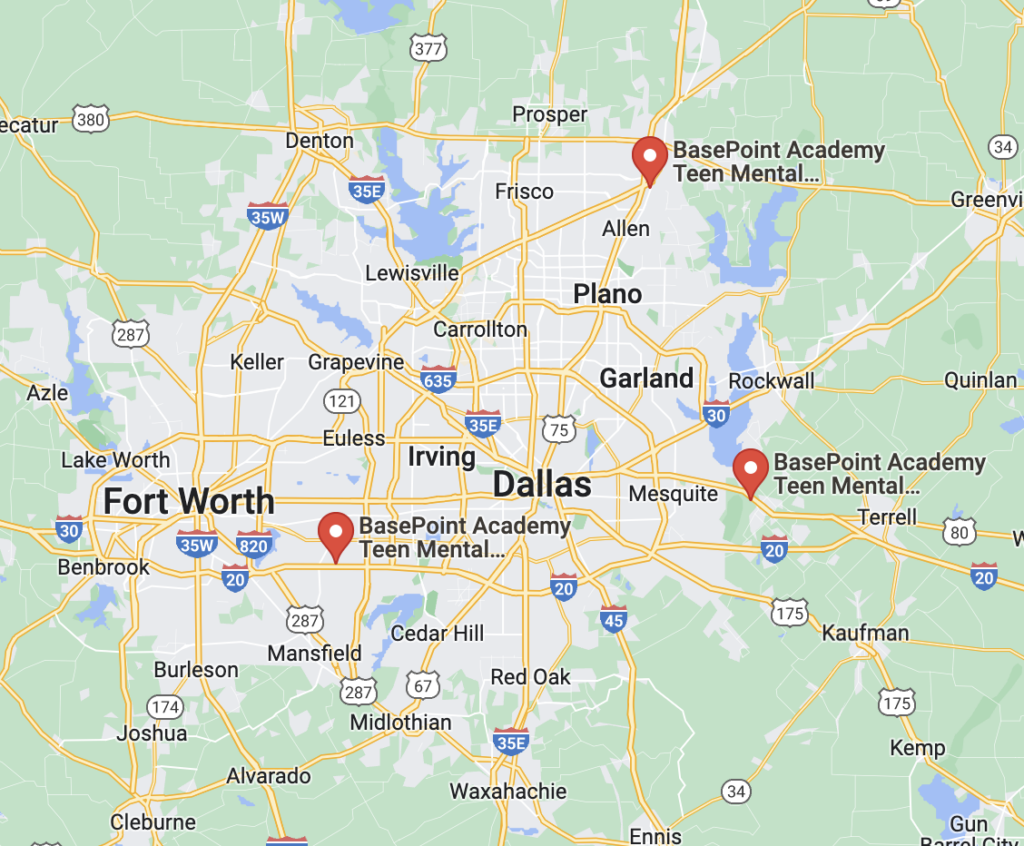
- Arlington, Texas: 3900 Arlington Highlands Blvd Suite 237, Arlington, TX 76018
- Forney, Texas: 713 W Broad St Suite 200, Forney, TX 75126
- Frisco, Texas: 8275 Judges Way #100i, Frisco, TX 75036
- McKinney, Texas: 4733 Medical Center Dr, McKinney, TX 75069
Exploring the Lone Star State and its Cities
Texas is well known for its sheer geographical size, taking up 268,597 square miles. The 28th state is also known for country music, cowboy culture, and independence. There’s a rich history of eating barbecue and chili. Most areas have an annual chili bake-off, and families’ chili recipes are closely guarded secrets.
The vast state is home to several large cities, including Dallas, Austin, Fort Worth, Houston, and San Antonio. Austin, Texas’ capital, is known as the live music capital of the world, drawing over 74,000 overseas tourists each year and boasting hundreds of concerts and dozens of music festivals. One of the Lone Star State’s most famous landmarks is the Alamo, near San Antonio, renowned for its role in the Texas Revolution.
Contact BasePoint Academy Today
Contact us today to schedule a confidential assessment for your teen with a licensed clinician.
You can also get in touch to talk with our mental health experts about treatment needs, care options and your insurance coverage levels.
Call: (972) 357-1749Check Your Insurance
How Many Times Will My Health Insurance Pay For Rehab for my Teenager?
The number of times a health insurance policy will pay for mental health rehabilitation depends on the policy. Some policies limit the number of treatments annually while others will only cover medically necessary services. When you call BasePoint Academy to have your insurance verified, the admissions specialist can also provide details on your health insurance policy’s rehab coverage benefits.
We understand your top priority is getting help for your child and adding financial hurdles can make the situation overwhelming. It is our goal to make treatment accessible to you and your teenager as we work closely with your insurance company to facilitate the most effective treatment and financial decisions.
Healthy interpersonal skills and identifying the signs of substance abuse, self-harm, and other mental health challenges can facilitate early intervention, crucial to recovery outcomes. Our treatment programs are specifically designed for each individual based on their mental health needs when they arrive at our facility.
Call (972) 357-1749 today to schedule a confidential assessment with our team so we can help your teen on the road to healthy, sustainable recovery in Dallas, Texas.
Contact BasePoint Academy Today!
Has your teen exhibited any of the symptoms discussed here? Does your teen have any of the risk factors outlined above? If you are concerned about the mental health of your teenager, it’s time to contact BasePoint Academy to discuss a treatment plan for your teen.
Some Statistics About Texas, Teens, and Mental Health
- Texas Health and Human Services notes that there is a diverse population of teens in Texas with a growing need for cultural awareness in healthcare. Mental health has an intense influence on academic achievement, physical health, and emotional well-being. Roughly 50% of mental health disorders begin in children age 14.
- Data from Mental Health America demonstrates that Texas has a high number of youth with mental illness and a lower rate of access to care. In 2022, 14.6% of teens aged 12 to 17 reported at least one major depressive episode (MDE) in the past year.
- According to the KFF, rates of adults with symptoms of depression or anxiety were higher in Texas than those for the U.S., with 36.8% of adults in Texas reporting depression and/or anxiety and 32.3% of adults across the U.S. reporting the same. Drug and opioid death rates were lower in Texas and the suicide rate was roughly the same.
- According to the Texas Court Appointed Special Advocate for Children, Texas ranked 45th for overall child well-being, having risen one spot since the 2021 ranking. The state ranks in the bottom half for economic well-being, education, health, family, and community.
- When left untreated, childhood depression is more likely to persist through adulthood. Roughly 9.7% of teens in Texas reported experiencing severe major depressive episodes and 3.49% reported a substance use disorder.
- Although Texas has relatively lower numbers of teens with major depressive episodes, they have much higher numbers of teens who have not receive mental health services. In fact, Texas has the highest percentage of teens who haven’t received services, with 73.1% of all teens with MDE having not received help.
- According to Mental Health America, 13.8% of teens from Texas did not have insurance that could cover mental or emotional problems.
- According to the National Alliance on Mental Health Illness – Texas, 1 in 6 youth aged 6 to 17 living in Texas experience a mental health disorder each year, and 314,000 aged 12 to 17 have depression. High school students who were depressed were twice as likely to drop out of school as their peers and 7 out of every 10 youth in the juvenile justice system have a mental health condition.